
Skip to content

Original practice packet

Hard SAT Algebra Practice: Restrictions, Parameters and Representations

Twelve original algebra challenges with domain checks, alternate representations, full answer reasoning and a printable practice packet.

Reviewed

Before you start

Work without the answer key, record your method, then verify the original equation or condition. Hard describes PeakSAT practice difficulty, not official SAT adaptive routing or calibrated score level. Graphs can support numerical checks; exact reasoning establishes restrictions and identities.

A decision method to use

  1. Record domain restrictions before canceling or squaring.
  2. Translate the requested quantity: input, output, sum, coefficient, rate or interval.
  3. Choose the form that exposes it: factored, vertex, discriminant, multiplier or compound inequality.
  4. Keep extraneous candidates separate from solutions.
  5. Substitute into the original problem and compare a second representation.
  6. Check units, endpoints and whether a model prediction is an observed value.
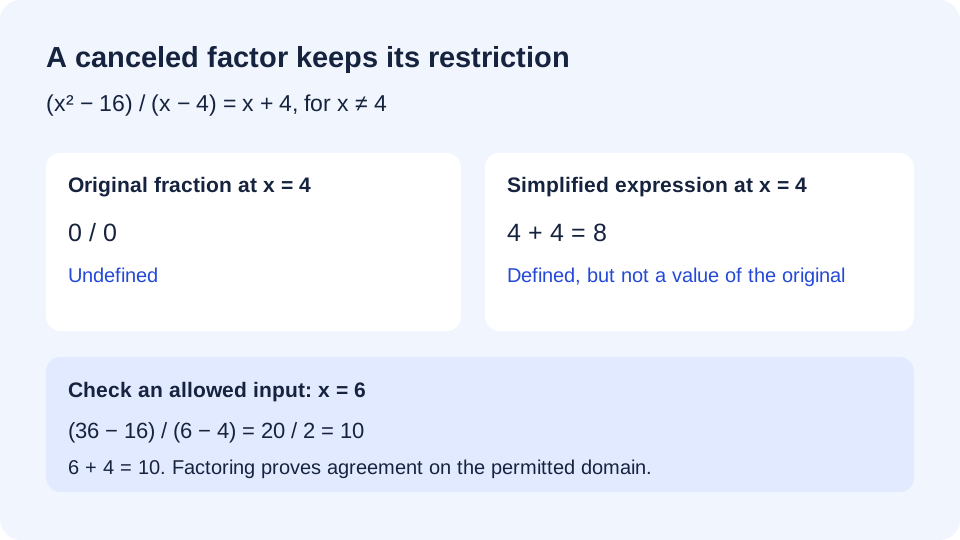
Domain check: (x squared minus 16)/(x minus 4) agrees with x plus 4 only for x not equal to 4. At 4 the original is undefined; at 6 both equal 10.
A numerical spot check supports the work; factorization and the original restriction establish the permitted equality.Open full-size image: Domain check: (x squared minus 16)/(x minus 4) agrees with x plus 4 only for x not equal to 4. At 4 the original is undefined; at 6 both equal 10.

Attempt the 12 questions

Checked 0 of 12, 0 correct

Practice feedback only, not an SAT score, a diagnostic or a calibrated difficulty level. Nothing here is saved.

  1. Question 1 of 12

    Rational restrictions

    For x ≠ 3, simplify (x² − 9)/(x² − 6x + 9).

    Choose one answer for question 1
    Reveal answer and reasoning for question 1

    Correct answer

    Choice B: (x + 3)/(x − 3)

    Explanation

    Factor the numerator as (x − 3)(x + 3) and the denominator as (x − 3)². Cancel one nonzero factor x − 3 and retain x ≠ 3.

    Why each choice is right or wrong

    1. Choice A

      Only one factor cancels; the remaining factors are different.

    2. Choice B

      , Correct answer

      This is the quotient of the remaining factors.

    3. Choice C

      This reverses numerator and denominator.

    4. Choice D

      One factor x − 3 remains in the denominator.

    Fresh check

    Is x = −3 permitted, and what is the original value there?

    Show the check answer for question 1

    Answer

    Yes; the value is 0.

    Why

    The denominator is 36, so the original fraction is defined. Only x = 3 is excluded.

  2. Question 2 of 12

    Extraneous radical roots

    Which value solves √(x + 6) = x?

    Choose one answer for question 2
    Reveal answer and reasoning for question 2

    Correct answer

    Choice C: 3

    Explanation

    The right side must be nonnegative. Squaring gives x + 6 = x², or (x − 3)(x + 2) = 0. Only 3 passes the original equation: √9 = 3.

    Why each choice is right or wrong

    1. Choice A

      −2 passes the squared equation but √4 = 2, not −2.

    2. Choice B

      √8 is not 2.

    3. Choice C

      , Correct answer

      3 satisfies √9 = 3.

    4. Choice D

      A negative right side cannot equal the principal square root.

    Fresh check

    Solve √(x + 12) = x for real x.

    Show the check answer for question 2

    Answer

    4.

    Why

    Squaring gives (x − 4)(x + 3) = 0. The negative candidate −3 fails the original equation; 4 passes.

  3. Question 3 of 12

    Parameter and discriminant

    For what value of k does x² − 10x + k = 0 have exactly one distinct real solution?

    Choose one answer for question 3
    Reveal answer and reasoning for question 3

    Correct answer

    Choice D: 25

    Explanation

    A quadratic has one repeated real root when its discriminant is zero. 100 − 4k = 0 gives k = 25; the polynomial is (x − 5)².

    Why each choice is right or wrong

    1. Choice A

      k = 5 gives positive discriminant 80 and two distinct real roots.

    2. Choice B

      k = 10 gives positive discriminant 60.

    3. Choice C

      k = 20 gives positive discriminant 20.

    4. Choice D

      , Correct answer

      k = 25 makes the discriminant zero and the root repeated.

    Fresh check

    For what k does 2x² − 8x + k = 0 have one distinct real root?

    Show the check answer for question 3

    Answer

    8.

    Why

    64 − 8k = 0, so k = 8. Then 2(x − 2)² = 0.

  4. Question 4 of 12

    Vertex with restricted domain

    For 0 ≤ x ≤ 2, what is the maximum value of f(x) = −2(x − 4)² + 30?

    Choose one answer for question 4
    Reveal answer and reasoning for question 4

    Correct answer

    Choice B: 22

    Explanation

    The vertex x = 4 is outside the interval. On 0 ≤ x ≤ 2, the squared distance from 4 is smallest at x = 2. f(2) = 22; f(0) = −2.

    Why each choice is right or wrong

    1. Choice A

      2 is the maximizing input, not the output.

    2. Choice B

      , Correct answer

      22 is the largest output on the permitted interval.

    3. Choice C

      30 occurs at x = 4, which the domain excludes.

    4. Choice D

      −2 is the output at the other endpoint and is smaller.

    Fresh check

    What is the maximum of this same function on 3 ≤ x ≤ 5?

    Show the check answer for question 4

    Answer

    30.

    Why

    The new interval includes the vertex x = 4, where the negative square term is zero.

  5. Question 5 of 12

    Nonlinear system and requested quantity

    The system y = x² and y = 2x + 8 has two real solutions. What is the sum of their y-coordinates?

    Choose one answer for question 5
    Reveal answer and reasoning for question 5

    Correct answer

    Choice D: 20

    Explanation

    Equate the expressions: x² − 2x − 8 = 0 = (x − 4)(x + 2). The solutions have x = 4, −2 and y = 16, 4. The requested sum is 20.

    Why each choice is right or wrong

    1. Choice A

      2 is the sum of x-coordinates.

    2. Choice B

      4 is just one y-coordinate.

    3. Choice C

      16 is the other y-coordinate.

    4. Choice D

      , Correct answer

      20 adds both y-coordinates.

    Fresh check

    Without listing y values, use y = 2x + 8 and x₁ + x₂ = 2 to calculate y₁ + y₂.

    Show the check answer for question 5

    Answer

    20.

    Why

    Add the two linear equations: y₁ + y₂ = 2(x₁ + x₂) + 16 = 20.

  6. Question 6 of 12

    Exponent scale

    A population model is P(t) = 900(1.08)^(t/3), with t in months. What percentage increase does the model predict every 3 months?

    Choose one answer for question 6
    Reveal answer and reasoning for question 6

    Correct answer

    Choice C: 8%

    Explanation

    Increasing t by 3 increases the exponent by 1, so the model multiplies by 1.08. This corresponds to an 8% increase per three-month period.

    Why each choice is right or wrong

    1. Choice A

      Approximately 2.6% is the implied monthly rate, not the rate for 3 months.

    2. Choice B

      The denominator 3 is a time scale, not a percentage.

    3. Choice C

      , Correct answer

      8% matches the multiplier 1.08 every 3 months.

    4. Choice D

      Multiplying the 8% rate by 3 ignores the stated exponent scale.

    Fresh check

    What is the multiplier after 6 months?

    Show the check answer for question 6

    Answer

    1.1664.

    Why

    Six months is two periods, so 1.08² = 1.1664. The total increase is 16.64%, not 16%.

  7. Question 7 of 12

    Equivalent quadratic representations

    A quadratic has zeros −2 and 5 and passes through (0, −20). Which expression defines it?

    Choose one answer for question 7
    Reveal answer and reasoning for question 7

    Correct answer

    Choice B: 2(x + 2)(x − 5)

    Explanation

    The roots give f(x) = a(x + 2)(x − 5). f(0) = −10a = −20 gives a = 2.

    Why each choice is right or wrong

    1. Choice A

      This gives f(0) = −10 rather than −20.

    2. Choice B

      , Correct answer

      This has the required zeros and f(0) = −20.

    3. Choice C

      This gives f(0) = 20.

    4. Choice D

      Its roots are 2 and −5, with the wrong signs.

    Fresh check

    Expand the correct expression.

    Show the check answer for question 7

    Answer

    2x² − 6x − 20.

    Why

    (x + 2)(x − 5) = x² − 3x − 10; multiply every term by 2.

  8. Question 8 of 12

    System parameter

    For what value of k does the system 3x − 2y = 7 and 6x − 4y = k have infinitely many solutions?

    Choose one answer for question 8
    Reveal answer and reasoning for question 8

    Correct answer

    Choice C: 14

    Explanation

    The second left side is twice the first. Its right side must also be twice 7, or 14, for the equations to represent the same line.

    Why each choice is right or wrong

    1. Choice A

      Matching the first constant does not match the scale factor.

    2. Choice B

      12 does not equal twice 7.

    3. Choice C

      , Correct answer

      14 makes every term in the second equation twice the first.

    4. Choice D

      28 is four times 7 rather than twice.

    Fresh check

    What happens if k = 15?

    Show the check answer for question 8

    Answer

    No solutions.

    Why

    Doubling the first equation gives the same left side equal to 14. It cannot simultaneously equal 15.

  9. Question 9 of 12

    Absolute value interval

    Which interval describes all real solutions to |2x − 5| < 3?

    Choose one answer for question 9
    Reveal answer and reasoning for question 9

    Correct answer

    Choice A: 1 < x < 4

    Explanation

    Write −3 < 2x − 5 < 3. Add 5: 2 < 2x < 8. Divide by 2: 1 < x < 4. The strict inequality excludes both endpoints.

    Why each choice is right or wrong

    1. Choice A

      , Correct answer

      This follows the compound inequality and excludes the endpoints.

    2. Choice B

      This describes the outside intervals and would fit the opposite comparison.

    3. Choice C

      This reverses signs without an algebraic basis.

    4. Choice D

      These are bounds on 2x − 5, not directly on x.

    Fresh check

    How does the answer change for |2x − 5| ≤ 3?

    Show the check answer for question 9

    Answer

    1 ≤ x ≤ 4.

    Why

    The algebra is unchanged, but equality now permits both endpoints.

  10. Question 10 of 12

    Rational equation

    What real value of x solves 1/(x − 2) = 3/(x + 2)?

    Choose one answer for question 10
    Reveal answer and reasoning for question 10

    Correct answer

    Choice D: 4

    Explanation

    Exclude x = 2 and x = −2. Cross-multiply nonzero denominators: x + 2 = 3x − 6, so x = 4. Substitution gives 1/2 = 3/6.

    Why each choice is right or wrong

    1. Choice A

      At −4, the two sides are −1/6 and −3/2, not equal.

    2. Choice B

      At 0, the sides have opposite signs.

    3. Choice C

      At 2, the first denominator is zero.

    4. Choice D

      , Correct answer

      4 satisfies the original equation and both domain restrictions.

    Fresh check

    Solve 2/(x − 1) = 5/(x + 2).

    Show the check answer for question 10

    Answer

    3.

    Why

    Exclude 1 and −2. 2x + 4 = 5x − 5 gives x = 3. Check 2/2 = 5/5 = 1.

  11. Question 11 of 12

    Function composition

    If f(x) = 2x − 3 and g(x) = x² + 1, what is g(f(4))?

    Choose one answer for question 11
    Reveal answer and reasoning for question 11

    Correct answer

    Choice C: 26

    Explanation

    Evaluate the inside first: f(4) = 5. Then g(5) = 25 + 1 = 26.

    Why each choice is right or wrong

    1. Choice A

      6 omits the square in the outer function, treating g(5) as 5 + 1.

    2. Choice B

      25 squares the inner result but omits the added 1.

    3. Choice C

      , Correct answer

      26 evaluates f first, then substitutes its output into g.

    4. Choice D

      31 evaluates f(g(4)) in the reversed order.

    Fresh check

    What is f(g(4))?

    Show the check answer for question 11

    Answer

    31.

    Why

    g(4) = 17, then f(17) = 34 − 3 = 31. Function order matters.

  12. Question 12 of 12

    Quadratic coefficients from root relations

    The equation 2x² − bx + 18 = 0 has two real roots whose sum is 7. What is b?

    Choose one answer for question 12
    Reveal answer and reasoning for question 12

    Correct answer

    Choice C: 14

    Explanation

    For ax² + cx + d = 0, root sum is −c/a. Here c = −b and a = 2, so the sum is b/2 = 7. Therefore b = 14.

    Why each choice is right or wrong

    1. Choice A

      7 ignores the leading coefficient 2.

    2. Choice B

      9 is the product of the roots, 18/2.

    3. Choice C

      , Correct answer

      14 makes the sum b/2 equal 7.

    4. Choice D

      18 is the constant term, not the requested coefficient.

    Fresh check

    With b = 14, are the roots real?

    Show the check answer for question 12

    Answer

    Yes.

    Why

    The discriminant is (−14)² − 4(2)(18) = 52, which is positive. There are two distinct real roots.

Keep going with equivalent expressions practice, nonlinear equations practice, nonlinear functions practice, nonlinear systems practice and linear systems practice, or print the full packet (PDF): Hard SAT Algebra Practice: Restrictions, Parameters and Representations.

Downloads

Files open or save in your browser. No account is needed.

Use this packet in class or at home

You may print, download and share unchanged PeakSAT-created worksheet files for personal study, classroom teaching and nonprofit advising, with attribution to PeakSAT and the original resource link. This permission does not cover resale, republishing the full material as your own, logos, third-party materials or official College Board questions. Public packets require no account. Signed-in product features have separate access requirements.

Sources

  1. College Board: SAT Math contentsatsuite.collegeboard.org

Sources are linked for reference; they do not endorse PeakSAT. How we prepare our guides