
Skip to content

Original practice packet

SAT Grammar Practice Packet: Clause Boundaries and Sentence Structure

Twelve original grammar questions with a clause decision chart, every-choice explanations, transfer checks and a printable answer key.

Reviewed

Before you start

Attempt all 12 questions before reading the key. For each blank, underline the main subject and finite verb, then identify whether each side is independent. This is original PeakSAT practice, not an official SAT test or score predictor.

A decision method to use

  1. Read the entire sentence.
  2. Find the main subject and finite verb.
  3. Test whether each side can stand alone.
  4. Two independent clauses: a period, semicolon, or comma plus coordinating conjunction can work.
  5. Introductory dependent clause: use a comma before the main clause.
  6. Colon: first require a complete clause, then an explanation or list.
  7. Check modifiers, agreement and parallelism separately. Do not put punctuation between a subject and its verb or a verb and its object.
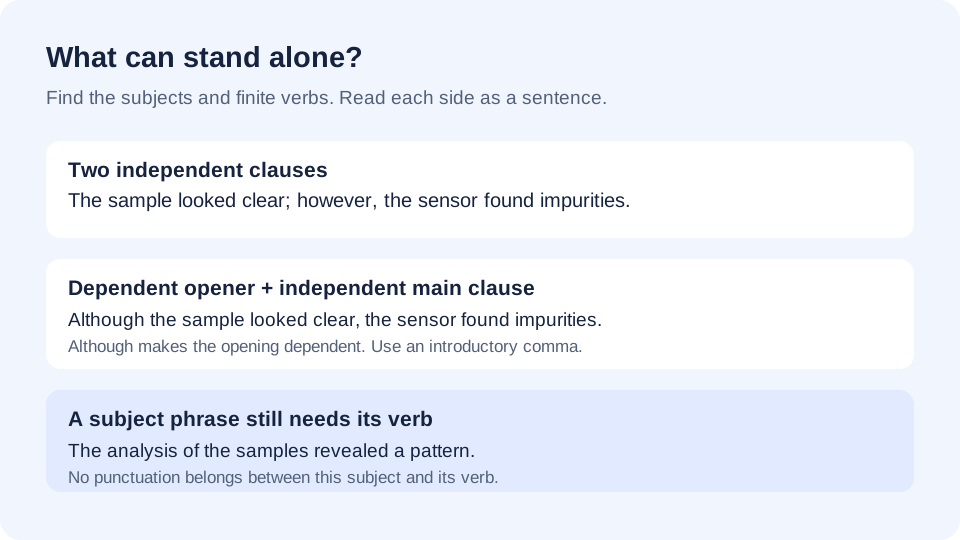
Clause decision chart: two independent clauses need a strong boundary; an introductory although-clause takes a comma; a subject phrase connects directly to its verb.
Recheck the structure whenever the wording changes.Open full-size image: Clause decision chart: two independent clauses need a strong boundary; an introductory although-clause takes a comma; a subject phrase connects directly to its verb.

Attempt the 12 questions

Checked 0 of 12, 0 correct

Practice feedback only, not an SAT score, a diagnostic or a calibrated difficulty level. Nothing here is saved.

  1. Question 1 of 12

    Independent clauses

    The telescope was small___it revealed unusually faint stars. Which choice creates a conventional boundary?

    Choose one answer for question 1
    Reveal answer and reasoning for question 1

    Correct answer

    Choice B: semicolon

    Explanation

    Each side has a subject, a finite verb and a complete thought. A semicolon joins the related independent clauses.

    Why each choice is right or wrong

    1. Choice A

      A comma alone splices two independent clauses.

    2. Choice B

      , Correct answer

      A semicolon makes a valid boundary between the complete clauses.

    3. Choice C

      No punctuation creates a fused sentence.

    4. Choice D

      A colon followed immediately by a comma is not a conventional boundary.

    Fresh check

    Join “The battery was charged” and “the sensor resumed recording” with one mark.

    Show the check answer for question 1

    Answer

    semicolon

    Why

    Both clauses are independent, so a semicolon works. A period would also work if the second clause were capitalized.

  2. Question 2 of 12

    Introductory dependent clauses

    Although the archive opened late___the visitors completed their research. Which choice fits?

    Choose one answer for question 2
    Reveal answer and reasoning for question 2

    Correct answer

    Choice B: comma

    Explanation

    Although makes the opening clause dependent. An introductory dependent clause is followed by a comma before the main clause.

    Why each choice is right or wrong

    1. Choice A

      A semicolon requires an independent clause on each side here.

    2. Choice B

      , Correct answer

      A comma separates the introductory dependent clause from the independent main clause.

    3. Choice C

      A colon should follow a complete clause; this opening is dependent.

    4. Choice D

      Omitting the boundary fails to separate the introductory clause conventionally.

    Fresh check

    Complete: “Because the labels had faded___the curator replaced them.”

    Show the check answer for question 2

    Answer

    comma

    Why

    Because creates an introductory dependent clause. It is followed by a comma.

  3. Question 3 of 12

    Conjunctive adverbs

    The first batch failed___however, the revised process produced a usable sample. Which choice fits?

    Choose one answer for question 3
    Reveal answer and reasoning for question 3

    Correct answer

    Choice C: semicolon

    Explanation

    However is a transition, not a coordinating conjunction. The two independent clauses need a strong boundary; the existing comma sets off however.

    Why each choice is right or wrong

    1. Choice A

      A comma alone creates a comma splice.

    2. Choice B

      No punctuation creates a fused sentence.

    3. Choice C

      , Correct answer

      A semicolon separates the independent clauses; the comma after however is already supplied.

    4. Choice D

      The extra comma immediately after the semicolon has no grammatical role.

    Fresh check

    Complete: “The original route was blocked___therefore, the hikers took a detour.”

    Show the check answer for question 3

    Answer

    semicolon

    Why

    Therefore is a conjunctive adverb between two complete clauses.

  4. Question 4 of 12

    Coordinating conjunctions

    The sound was faint___but the microphone captured it clearly. Which choice fits?

    Choose one answer for question 4
    Reveal answer and reasoning for question 4

    Correct answer

    Choice A: comma

    Explanation

    But is a coordinating conjunction joining two independent clauses. A comma before but makes the standard boundary.

    Why each choice is right or wrong

    1. Choice A

      , Correct answer

      A comma followed by but joins the complete clauses conventionally.

    2. Choice B

      The semicolon-comma combination is unnecessary and invalid here.

    3. Choice C

      The colon-comma combination is not a conventional boundary.

    4. Choice D

      These two independent clauses call for a comma before but in this construction.

    Fresh check

    Complete: “The gate was locked___so the team used another entrance.”

    Show the check answer for question 4

    Answer

    comma

    Why

    So joins two independent clauses as a coordinating conjunction.

  5. Question 5 of 12

    Colons introducing explanations

    The kit contained three essentials___a ruler, a compass, and a notebook. Which choice conventionally introduces the list?

    Choose one answer for question 5
    Reveal answer and reasoning for question 5

    Correct answer

    Choice A: colon

    Explanation

    The words before the blank form a complete clause. A colon introduces the list that identifies the three essentials.

    Why each choice is right or wrong

    1. Choice A

      , Correct answer

      A colon follows a complete clause and introduces its explanatory list.

    2. Choice B

      The list is not an independent clause, so a semicolon does not work.

    3. Choice C

      The list needs a boundary after the complete opening clause.

    4. Choice D

      And does not connect the list conventionally to the preceding complete sentence in this wording.

    Fresh check

    May a colon follow “The kit contained” before a list?

    Show the check answer for question 5

    Answer

    No.

    Why

    That would separate the verb from its objects. “The kit contained a ruler, a compass, and a notebook” needs no colon.

  6. Question 6 of 12

    Essential modifiers

    The students___who completed the safety training___could use the laboratory. The writer means only the trained students. Which punctuation fits both blanks?

    Choose one answer for question 6
    Reveal answer and reasoning for question 6

    Correct answer

    Choice B: no punctuation in either

    Explanation

    Who completed the safety training restricts which students are meant. An essential modifier is not enclosed in commas.

    Why each choice is right or wrong

    1. Choice A

      Commas would present the modifier as extra information and change the intended restriction.

    2. Choice B

      , Correct answer

      No commas preserve the restriction to trained students.

    3. Choice C

      Semicolons cannot separate this relative clause from its noun and main verb.

    4. Choice D

      Colons do not enclose a restrictive relative clause.

    Fresh check

    Does “The students, who completed the training, entered” restrict the statement to a subgroup?

    Show the check answer for question 6

    Answer

    No.

    Why

    The comma-enclosed modifier presents the training as additional information about the identified students.

  7. Question 7 of 12

    Nonessential appositives

    The expedition leader___a skilled navigator___charted a new route. Which paired punctuation treats the middle phrase as extra description?

    Choose one answer for question 7
    Reveal answer and reasoning for question 7

    Correct answer

    Choice B: commas

    Explanation

    A skilled navigator is a nonessential appositive describing the already identified leader. It needs matching boundaries on both sides.

    Why each choice is right or wrong

    1. Choice A

      Without boundaries, the inserted appositive is not set off.

    2. Choice B

      , Correct answer

      Matching commas enclose the appositive.

    3. Choice C

      Semicolons are not boundaries for this phrase.

    4. Choice D

      A colon after the subject interrupts the subject-verb connection, and the phrase lacks a closing boundary.

    Fresh check

    Remove the appositive from the original sentence. What remains?

    Show the check answer for question 7

    Answer

    The expedition leader charted a new route.

    Why

    The remaining complete sentence confirms that the inserted description is structurally optional.

  8. Question 8 of 12

    Subject-verb boundaries

    The analysis of the samples___revealed a previously unnoticed pattern. Which choice fits?

    Choose one answer for question 8
    Reveal answer and reasoning for question 8

    Correct answer

    Choice D: no punctuation

    Explanation

    The main subject is analysis, followed by its verb revealed. The intervening prepositional phrase does not create a punctuation boundary.

    Why each choice is right or wrong

    1. Choice A

      A comma would unnecessarily separate the subject from its verb.

    2. Choice B

      The text before the blank is only the subject phrase, not a complete clause.

    3. Choice C

      A colon would interrupt the subject-verb connection.

    4. Choice D

      , Correct answer

      No punctuation keeps the main subject connected to its verb.

    Fresh check

    Identify the subject and verb in “The color of the stones changed.”

    Show the check answer for question 8

    Answer

    Subject: color. Verb: changed.

    Why

    Of the stones modifies color; it does not create a separate clause.

  9. Question 9 of 12

    Relative clauses versus main verbs

    The instrument, which measures tiny vibrations, ___ sensitive enough to detect the signal. Which choice makes a complete grammatical sentence?

    Choose one answer for question 9
    Reveal answer and reasoning for question 9

    Correct answer

    Choice B: is

    Explanation

    Measures belongs to the relative clause. The main subject instrument still needs the finite main verb is.

    Why each choice is right or wrong

    1. Choice A

      Being alone is not a finite main verb.

    2. Choice B

      , Correct answer

      Is supplies the required singular finite main verb.

    3. Choice C

      To be is an infinitive and cannot serve as the main finite verb here.

    4. Choice D

      And supplies neither a verb nor a complete predicate.

    Fresh check

    Complete: “The instruments, which measure tiny vibrations, ___ sensitive.”

    Show the check answer for question 9

    Answer

    are

    Why

    The plural main subject instruments requires are. The verb within which-clause does not replace the main verb.

  10. Question 10 of 12

    Participial modifiers

    Carrying the replacement lens, ___ entered the observatory. Which completion avoids a dangling modifier?

    Choose one answer for question 10
    Reveal answer and reasoning for question 10

    Correct answer

    Choice B: the technician

    Explanation

    The introductory phrase describes the person carrying the lens. The main subject should identify that person.

    Why each choice is right or wrong

    1. Choice A

      A case is not the intended person carrying the lens.

    2. Choice B

      , Correct answer

      The technician is the logical doer of carrying and entered.

    3. Choice C

      There does not identify a person carrying the lens.

    4. Choice D

      A door cannot perform the described actions.

    Fresh check

    Repair: “Walking toward the lab, the notebook fell from Maya’s bag.”

    Show the check answer for question 10

    Answer

    As Maya walked toward the lab, the notebook fell from her bag.

    Why

    The revision explicitly assigns walking to Maya rather than the notebook.

  11. Question 11 of 12

    Agreement across phrases

    Each of the sketches ___ a different stage of the design. Choose the correct present-tense verb.

    Choose one answer for question 11
    Reveal answer and reasoning for question 11

    Correct answer

    Choice B: shows

    Explanation

    The main subject each is singular. Of the sketches is a modifying phrase, so the plural sketches does not control agreement.

    Why each choice is right or wrong

    1. Choice A

      Show does not agree with singular each in this sentence.

    2. Choice B

      , Correct answer

      Shows is the singular present-tense form.

    3. Choice C

      Are is plural and does not agree with each.

    4. Choice D

      Have is plural here and also changes the requested tense.

    Fresh check

    Complete: “Several of the sketches ___ a different stage.”

    Show the check answer for question 11

    Answer

    show

    Why

    Several is plural. Changing each to several changes the controlling subject.

  12. Question 12 of 12

    Parallel structure

    The workshop teaches students to observe carefully, to record measurements, and ___. Which choice completes the parallel list?

    Choose one answer for question 12
    Reveal answer and reasoning for question 12

    Correct answer

    Choice C: to analyze results

    Explanation

    The first two list items are infinitive phrases. To analyze results gives the third item the same grammatical form.

    Why each choice is right or wrong

    1. Choice A

      The -ing phrase breaks the established infinitive pattern.

    2. Choice B

      The noun phrase breaks the pattern.

    3. Choice C

      , Correct answer

      The infinitive phrase matches to observe and to record.

    4. Choice D

      The independent clause changes both structure and subject.

    Fresh check

    Complete the alternative list: “observing carefully, recording measurements, and ___.”

    Show the check answer for question 12

    Answer

    analyzing results

    Why

    Here all three items use -ing phrases. Parallelism depends on the actual pattern.

Keep going with sentence boundaries practice and form structure sense practice, or print the full packet (PDF): SAT Grammar Practice Packet: Clause Boundaries and Sentence Structure.

Downloads

Files open or save in your browser. No account is needed.

Use this packet in class or at home

You may print, download and share unchanged PeakSAT-created worksheet files for personal study, classroom teaching and nonprofit advising, with attribution to PeakSAT and the original resource link. This permission does not cover resale, republishing the full material as your own, logos, third-party materials or official College Board questions. Public packets require no account. Signed-in product features have separate access requirements.

Sources

  1. College Board: Reading and Writing content domainssatsuite.collegeboard.org

Sources are linked for reference; they do not endorse PeakSAT. How we prepare our guides