
Desmos walkthrough
How to Solve SAT Linear Systems with Desmos
An original Desmos walkthrough for two linear equations: enter them, read the intersection, verify both equations and distinguish one, none or infinitely many solutions.
Reviewed
The short answer
To solve a two-variable system graphically, enter both equations in Desmos and inspect their intersection. The intersection’s coordinates must satisfy both original equations. Read whether the problem asks for x, y or a combination of them. A clear numerical intersection is a useful method; algebra gives an exact check and helps when graphs overlap or the requested result is symbolic.
On this page
Enter both original equations
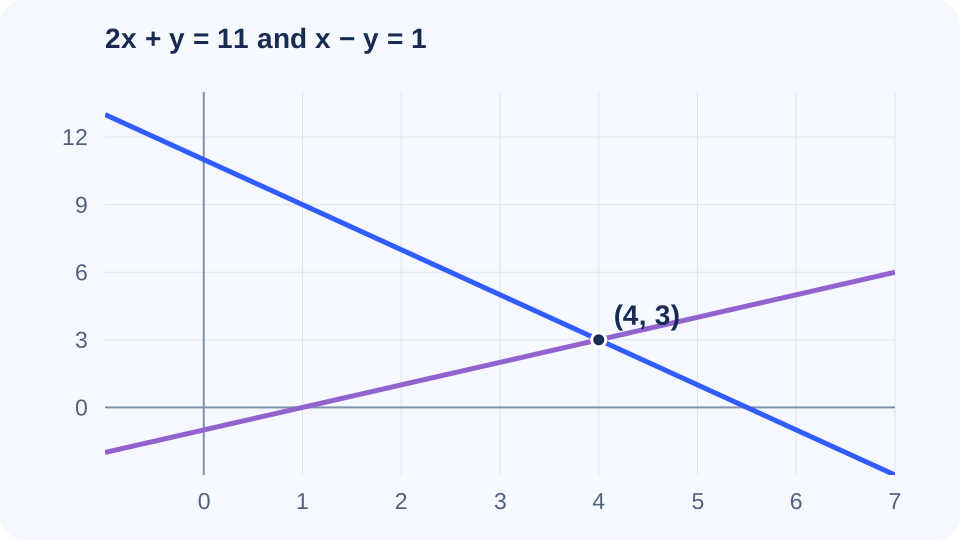
Solve the original system 2x + y = 11 and x − y = 1. Enter each equation on its own expression line:
2x + y = 11
x - y = 1
You do not have to rearrange these linear equations before graphing. Use the official testing calculator for practice and confirm the workflow in Bluebook.
Read the point and verify it
Select a line and then the intersection point. For these equations the point is (4,3), so x = 4 and y = 3. Check both originals: 2(4) + 3 = 11 and 4 − 3 = 1. If the question asks for x + y, answer 7; if it asks for x, answer 4. A coordinate pair and a requested scalar are different answers.
Use elimination as the exact check
Add 2x + y = 11 and x − y = 1. The y terms cancel, giving 3x = 12 and x = 4. Substitute into x − y = 1 to get y = 3. This confirms the graph and avoids dependence on rounded coordinate labels.
Recognize the three possible line relationships
- Different slopes: exactly one intersection, hence one solution.
- Equal slopes and different intercepts: parallel lines, hence no solution.
- Equivalent equations: the same line, hence infinitely many solutions.
For example, y = 2x + 1 and y = 2x + 4 are parallel. The equations y = 2x + 1 and 2y = 4x + 2 represent the same line. Verify algebraically when two graphs appear to overlap.
Try a transfer problem
Enter 3x + y = 17 and x − y = 3. Before revealing a point, add the equations to obtain 4x = 20. Thus x = 5 and y = 2, and x + y = 7. Check 3(5) + 2 = 17 and 5 − 2 = 3. If the intersection is outside your view, adjust the window.
Sources
- Desmos: Getting started and points of interesthelp.desmos.com
- Desmos: College Board testing calculator differences, 2026–2027desmos.com
- College Board: SAT calculator policysatsuite.collegeboard.org
Sources are linked for reference; they do not endorse PeakSAT. How we prepare our guides