
Original practice · Math
SAT Quadratics: Find the Maximum Height of a Model
Use vertex form and the vertex formula to solve an original quadratic maximum problem and check the domain.
Reviewed
Before you start
Practice nonlinear functions with an original problem, a complete solution and a transfer check. Try the problem before reading the worked answer.
The original problem
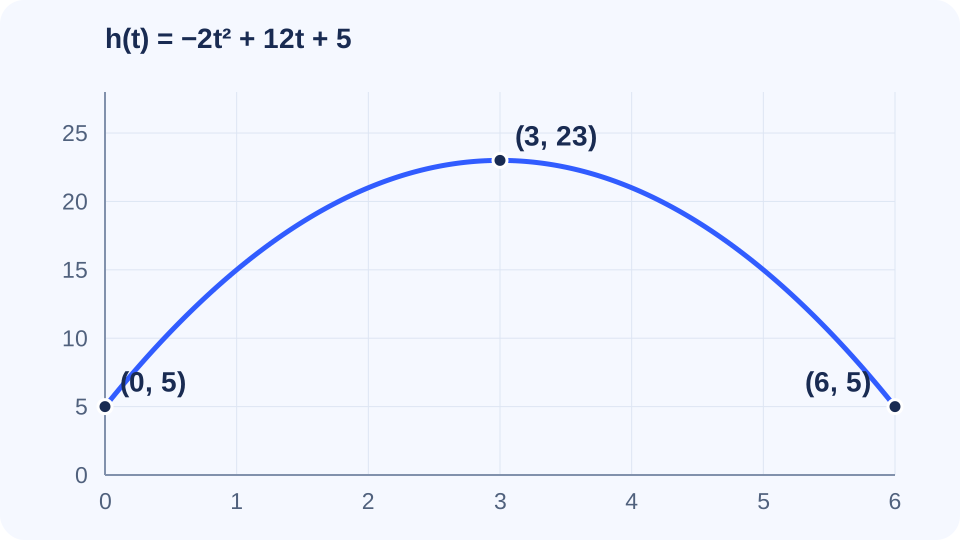
For 0 ≤ t ≤ 6, a model gives height h(t) = −2t² + 12t + 5, in meters. What is the maximum height predicted by the model?
Answer: 23 meters
Locate the vertex
The leading coefficient is negative, so the parabola opens downward. The vertex occurs at t = −b/(2a) = −12/(−4) = 3.
Evaluate the requested quantity
h(3) = −2(9) + 12(3) + 5 = −18 + 36 + 5 = 23. The question asks for height, not the time 3.
Check the permitted interval
t = 3 lies in 0 ≤ t ≤ 6. Both endpoints give height 5, so the vertex gives the interval maximum.
A second method or independent check
Complete the square: h(t) = −2(t² − 6t) + 5 = −2(t − 3)² + 23. A square is nonnegative, so −2(t − 3)² cannot exceed 0. The largest possible height is 23, attained at t = 3.
Why tempting answers fail
- 3 is the time at the maximum, not the height.
- 5 is the initial height and also the height at t = 6.
- 18 is the increase above the initial height, not the maximum height.
Try a transfer problem
For all real x, what is the maximum value of −3(x − 4)² + 29?
Answer: 29
The negative square term is at most 0. At x = 4 it equals 0, leaving 29.
What to practice next
If this was difficult, return to nonlinear functions practice and identify the precise step to improve. These are original PeakSAT teaching examples, not official College Board questions or calibrated score predictions. For official adaptive test practice, use Bluebook (opens in a new tab).
Sources
- College Board: SAT Math contentsatsuite.collegeboard.org
Sources are linked for reference; they do not endorse PeakSAT. How we prepare our guides