
Original practice · Math
SAT Trigonometry: Read Sine from a Right Triangle
Identify opposite, adjacent and hypotenuse in an original labeled right triangle, then calculate sine.
Reviewed
Before you start
Practice right triangles and trigonometry with an original problem, a complete solution and a transfer check. Try the problem before reading the worked answer.
The original problem
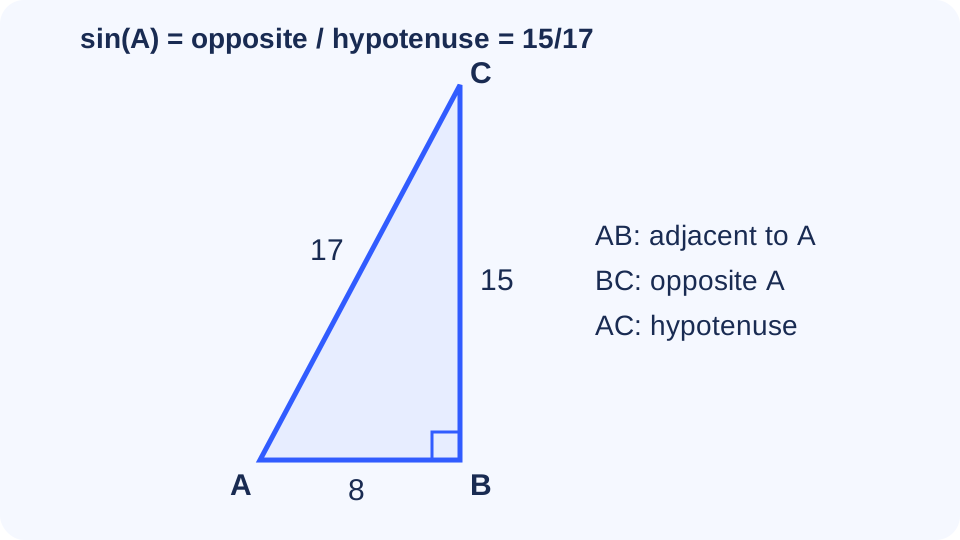
Right triangle ABC has a right angle at B. AB = 8 and BC = 15. What is sin(A)?
Answer: 15/17
Find the hypotenuse
AC is opposite the right angle. AC² = 8² + 15² = 64 + 225 = 289, so AC = 17.
Identify the side opposite angle A
BC, of length 15, is opposite angle A. AB, of length 8, is adjacent to A.
Apply the sine ratio
sin(A) = opposite/hypotenuse = BC/AC = 15/17.
A second method or independent check
Angle C is complementary to angle A. Its cosine uses its adjacent leg BC and the same hypotenuse AC: cos(C) = 15/17. The identity sin(A) = cos(C) provides a second check.
Why tempting answers fail
- 8/17 is cos(A), not sin(A).
- 8/15 is the reciprocal of tan(A).
- 15/8 is tan(A). Sine of this acute angle must be between 0 and 1.
Try a transfer problem
What is cos(A) for the same triangle?
Answer: 8/17
Cosine is adjacent/hypotenuse. Relative to A, AB is the adjacent leg, so cos(A) = 8/17.
What to practice next
If this was difficult, return to right triangles and trigonometry practice and identify the precise step to improve. These are original PeakSAT teaching examples, not official College Board questions or calibrated score predictions. For official adaptive test practice, use Bluebook (opens in a new tab).
Sources
- College Board: SAT Math contentsatsuite.collegeboard.org
Sources are linked for reference; they do not endorse PeakSAT. How we prepare our guides